Home / Horse Racing Form Guide
National Hunt and Flat Racing: Race Types and Classes Explained
A two-mile novice hurdle and a six-furlong Group 1 sprint are both horse races, and almost nothing else about them is the same. Here is how British races are sorted.
Published
British racing is two sports sharing the same courses. Flat racing is run without obstacles, over sprints and middle distances, and is about speed. National Hunt racing, the jumps, is run over hurdles and fences, usually over longer trips, and is about stamina and jumping as much as pace. Within each there are many kinds of race, and the kind of race changes how a bet should be approached.
This page sets out the main types, the class system that sorts them by quality, and what each tends to mean for the betting.
Flat racing
Flat races have no obstacles. In Britain they range from five furlongs, the shortest sprint, to just over two and a half miles for the longest race of all, run at Royal Ascot. A furlong is an eighth of a mile, 220 yards.
Flat racing takes place on turf and on all-weather tracks, which have synthetic surfaces. The Flat is also where horses start their careers, often as two-year-olds, and where the most valuable races for young horses are run.
On the Flat, horses start from stalls, and the draw, the stall a horse starts from, can matter at some tracks. It is printed on the racecard in brackets next to the racecard number. The pace of the race and the position a horse takes early can be decisive, particularly over short distances.
National Hunt racing
National Hunt is the British name for jump racing. There are three kinds of National Hunt race.
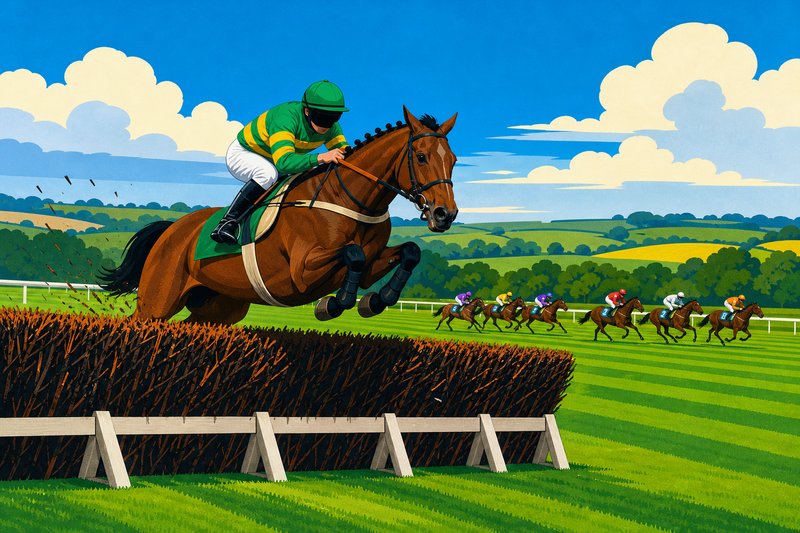
Hurdle races are run over hurdles: lighter, more flexible obstacles at least 3 feet 6 inches high. Horses usually start over hurdles before moving on to fences.
Steeplechases, or chases, are run over fences: bigger, more solid obstacles at least 4 feet 6 inches high, and at some courses with open ditches or water jumps as well. Chasers are generally older, more experienced jumpers.
National Hunt flat races, known as bumpers, have no obstacles at all. They are for young horses being prepared for a jumping career, and they let those horses gain racing experience before they are asked to jump in public.
Jump races start from a tape or flag rather than stalls, so there is no draw. Distances are longer than on the Flat, from around two miles up to well over four for the longest chases. Horses fall, unseat their riders or are pulled up far more often than on the Flat, which is why the letters F, U and P appear so often in jump form.
National Hunt racing runs through the year in Britain, but its biggest meetings, including the Cheltenham Festival and the Grand National meeting at Aintree, fall between autumn and spring.
Handicaps and conditions races
Within both codes, races are either handicaps or not, and the difference matters a great deal for betting.
In a handicap, each horse carries a weight based on its official rating, which the British Horseracing Authority’s handicappers set from its results. The idea is to give every runner an equal chance: a better horse carries more weight, a weaker one less. In theory, if the ratings are right, the horses should finish together. In practice they don’t, and the reason a handicap is won is often that one horse has improved faster than its rating has caught up with.
Handicaps make up a large part of the British programme, from low-grade races on weekday cards to big-field handicaps at major meetings. They are usually competitive and open, with prices spread across the field.
Races that aren’t handicaps are often called conditions races. The weights follow fixed rules in the race conditions, usually based on age and sex and sometimes on past wins, rather than individual ratings. The best horse in the race has the best chance, and the betting usually reflects that with a clear favourite.
Weight-for-age and allowances
Even outside handicaps, horses don’t always carry the same weight. Two adjustments come up often, and they explain figures on a racecard that can look odd at first.
Weight-for-age is a scale that gives younger horses a weight allowance when they race against older ones. A three-year-old is still maturing, so in a race open to three-year-olds and older horses, it carries less than a four-year-old to make the contest fair. The allowance shrinks through the season as the younger horses develop, and it differs with distance.
Sex allowances give fillies and mares a weight allowance in many races open to both sexes, for the same reason: to even out the competition.
Riders can bring allowances too. Some less experienced jockeys are entitled to claim a weight allowance, which reduces the weight the horse carries, and the racecard shows it next to the jockey’s name.
None of these changes what a race is. They do explain why the weights in a conditions race aren’t all identical, and why a lightly weighted runner isn’t necessarily a weak one. The race conditions in the heading spell out exactly which allowances apply.
Race classes
British races are graded into numbered classes, with Class 1 at the top. The class is printed in the race heading and is one of the quickest guides to the quality of the field.
Class 1 is the top level. It contains the Pattern races, the Group races on the Flat and the Grade races over jumps, along with Listed races and some of the most valuable handicaps. Below it, each class down is a step lower in quality and prize money, with Class 2 and Class 3 carrying strong handicaps and the lower classes the everyday racing that fills most weekday cards.
On the Flat, the old Class 7 was removed from February 2021. Races for the lowest-rated horses were moved into Class 6 as classified races instead. So on the Flat today, Class 6 is the lowest class you will see.
For a bettor, a change of class is one of the most useful things to notice. A horse dropping from a higher class into a lower one may find the opposition weaker than it is used to. A horse stepping up in class is taking on better horses than it has beaten before, and its form may flatter it.
Group, Grade and Listed races
At the top of the sport are the Pattern races. On the Flat they are called Group races: Group 1 is the highest level, Group 2 below it and Group 3 below that. Over jumps the same idea uses Grade 1, 2 and 3. Just below the Pattern races are Listed races.
These are the races that decide championships and build reputations, and they include the famous names: the Classics on the Flat, the Gold Cup and the Champion Hurdle at Cheltenham over jumps. They are usually conditions races rather than handicaps, so the best horse carries the same weight as the rest, or close to it, and often starts a short-priced favourite.
The Grand National is an exception worth knowing: it is a handicap, which is part of why its field is so big and its result so hard to call.
Maidens, novices and juveniles
Several race types are defined by a horse’s experience.
A maiden is a horse that has never won a race, and a maiden race is open only to such horses. These races are full of unexposed horses, some of whom will improve quickly, so form is thin and the betting can be guesswork.
A novice race is for horses early in their careers, restricted by how many races they have won. Over jumps, novice races are for horses that had not won over that type of obstacle before the current season began, so a horse can be a novice chaser even after a long career over hurdles.
A juvenile is a two-year-old on the Flat. Juvenile races are the first steps for many Flat horses, and the form changes quickly as the season goes on.
Racecards may also describe some races as sellers or claimers. In a selling race the winner is offered for sale at auction after the race, and in a claiming race any runner can be bought for a set price. They are lower-grade races, and the race heading spells out the terms.
What the race type means for a bet
Each kind of race has a character, and it shapes which bet makes sense.
A big-field handicap is open. Many horses have a chance, prices are spread out, and the each way terms are generous, with four places at a quarter of the odds when there are sixteen or more runners. That makes it the natural home of the each way bet, and of forecasts and tricasts for anyone with a view on more than the winner.
A small conditions race or a Group 1 with a standout horse is the opposite. The favourite is often odds-on, the place terms are poor, and each way is rarely worth it. A win single, or no bet, is the honest choice.
A maiden or bumper with little form is hard to read at all, and the market knows as little as anyone. Small stakes suit it.
Knowing whether a race is a handicap or not, which class it is, and whether it is Flat or National Hunt, takes seconds on a racecard, and it is the first thing worth checking before choosing either a horse or a bet. The form guide covers how to read the runners once you know the race, and the each way guide covers the terms for each size of field.