Home / Types of Horse Racing Bets in the UK, Explained from Single to Goliath
Each Way Bet Explained: How It Works, How Many Places Pay & Payouts
Two bets for the price of one decision: one on the horse to win, one on it to finish in the places. Here is how each half is settled and when the bet is worth having.
Published
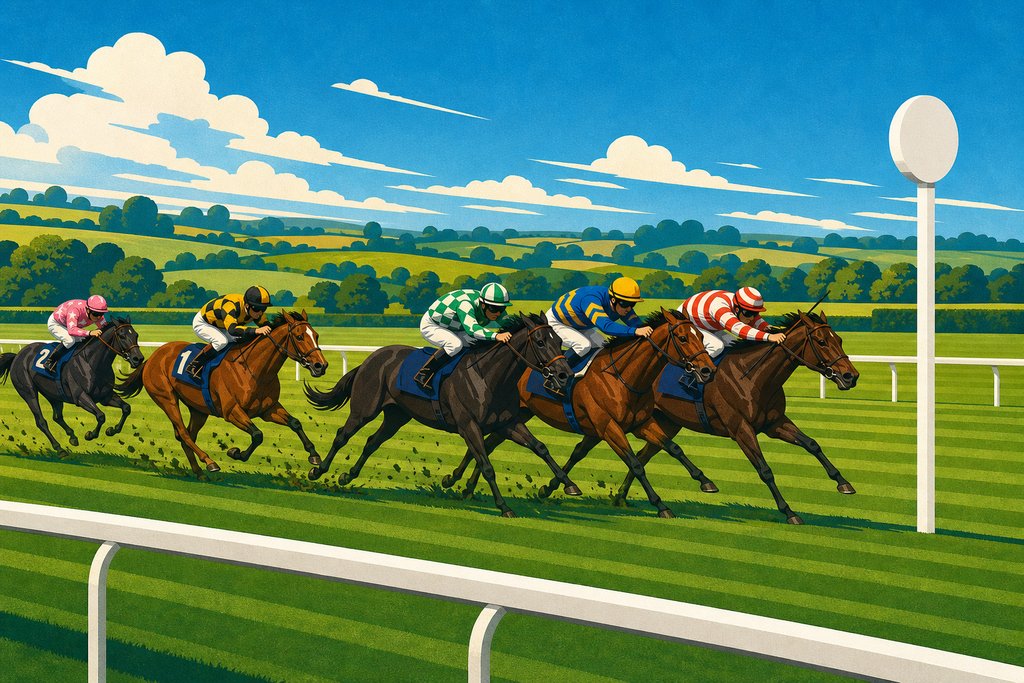
What does each way mean? It means your stake is placed twice on the same horse: once to win and once to finish in the places. £5 each way is a £5 win bet and a £5 place bet, so it costs £10. If the horse wins, both bets pay. If it finishes second or third, only the place bet does, and at a fraction of the win price.
That is the whole idea. The details are where it goes right or wrong: how many places the race pays, what fraction of the odds, and whether the price is big enough for a placed finish to be worth anything.
What does each way mean? Two bets, double the stake
So what does each way mean on a slip or a screen? You are backing the horse both ways. Betting shops print it as E/W, and on a slip you tick the E/W box next to your stake. The stake you write is the stake per half, so “£5 E/W” costs £10. It is easy to forget at the counter, so it is worth saying twice: an each way bet costs double the figure you write.
Online it works the same way. Tick each way on the bet slip and the total stake doubles. If you are working to a budget, halve the figure first: £10 to spend is £5 each way, not £10.
How does each way betting work? The win part and the place part
Each half is settled on its own, as if you had placed two separate bets.
The win part is an ordinary win single. It pays at the full price if the horse wins and loses otherwise.
The place part pays if the horse finishes in the paying places, and a winner counts as placed. It is paid at a fraction of the win price, set by the race: usually a quarter or a fifth. At 8/1 with 1/5 terms, the place price is 8/1 divided by 5, which is 8/5.
So there are three possible outcomes. The horse wins and both halves pay. The horse places and the place half pays while the win half loses. The horse finishes out of the places and both lose. That is how each way betting works on every race, from a Tuesday seller to the Gold Cup. So how does each way betting work, in one line? Two bets, settled one after the other.
The place part is always the smaller return, and that is the trade. You pay double to get paid something on a near miss.
One point trips people up: when the horse wins, the place half pays too. It is easy to assume that an each way bet pays one half or the other. It doesn’t. A winner has finished in the places, so both halves are settled as winners, and that is where most of the money in an each way bet comes from. If a friend asks “how does each way betting work?”, the answer to give is “two bets, and a winner collects on both”.
Each way places and terms explained
The terms are the part of an each way bet that gets explained least often. The number of places and the fraction depend on the size of the field and whether the race is a handicap. These are the standard UK terms:
| Race and runners | Places paid | Fraction of the odds |
|---|---|---|
| 2 to 4 runners, any race | Win only | No each way |
| 5 to 7 runners, any race | 1st and 2nd | 1/4 |
| 8 or more runners, non-handicap | 1st, 2nd and 3rd | 1/5 |
| Handicap, 8 to 11 runners | 1st, 2nd and 3rd | 1/5 |
| Handicap, 12 to 15 runners | 1st, 2nd and 3rd | 1/4 |
| Handicap, 16 or more runners | 1st to 4th | 1/4 |
The terms depend on the number of horses that come under starter’s orders, not the number declared when you placed the bet. That matters when horses are withdrawn, and there is a section on it below.
Many firms offer better than standard, most often extra places. On the biggest handicaps you will often see five, six or more places offered, and the numbers change from firm to firm and race to race. They are worth comparing, because an extra place is a straight improvement to the bet. Just use the terms printed on your own slip or bet screen, rather than the usual table, when you work out what you are owed.
Why do the terms step up and down like this? A place is easier to get in a small field and harder in a big one, and the fraction is there to keep the place price roughly in line with that chance. In a five-runner race, finishing second is a one-in-five shot for an average horse and pays only two places. In a 20-runner handicap, getting into the first four is much harder, so the fraction is more generous and there is an extra place. The scale is blunt, and that bluntness is exactly what makes some races better each way bets than others, as the section on value explains.
Three worked examples: won, placed, unplaced
All three use £10 each way at 8/1 in a race paying three places at 1/5 of the odds. The stake is £20.
The horse wins. The win half pays at 8/1: £10 × 9 = £90, which is £80 winnings plus the stake. The place half pays at 8/5: £10 × 2.6 = £26. Total return £116, a profit of £96.
The horse finishes third. The win half loses £10. The place half pays £26 as before. You get £26 back from £20, a profit of £6.
The horse finishes fourth. Both halves lose. Nothing comes back.
The middle case is the one people have in mind when they bet each way, and it is worth noticing how small it is. A placed 8/1 shot makes £6 on a £20 bet. The each way bet earns its money when the horse wins, and the place half is there to soften a near miss, not to turn one into a good day. The calculator at the bottom of this page is loaded with the winning case. Change the result to see the other two.
The same bet at 1/4 terms shows how much the fraction matters. The place price becomes 2/1 instead of 8/5, so the place half returns £30 instead of £26. A winner returns £120 and a placed horse £30, a £10 profit rather than £6. Over a season of each way bets, the difference between a quarter and a fifth is one of the biggest numbers you control, and it costs nothing to look for it.
When the bet is settled, the slip or the bet history shows both halves: a win line and a place line, each with its own return. That is each way explained on a receipt, and it is the quickest way to check a settlement. If the place line is missing on a horse you know placed, ask for it to be checked.
When an each way bet is worth it, and when it isn’t
The place half only pays for itself if the place price is evens or better. At 1/5 terms that means a win price of 5/1 or more. At 1/4 terms it is 4/1 or more. Below those lines, a placed horse returns less than the total stake, and the each way bet is a win bet with a costly extra.
A favourite shows the problem most clearly. £10 each way on a 4/6 shot that finishes second, at 1/5 terms, is paid a place price of 2/15, a fifth of 4/6. The place half returns £11.33. The stake was £20. You “won” your each way bet and lost £8.67. For short-priced horses, a straight win bet is almost always the better use of the money.
At the other end, each way works best on horses at bigger prices in races with good terms. A 12/1 shot in a 16-runner handicap paying four places at 1/4 has four chances to hit the frame, and a placed finish pays 3/1 on the place half. That is the classic each way bet.
A rough rule by price, at standard terms:
Below 4/1, a placed finish loses money on the bet as a whole, so a win bet is the cleaner choice. Between about 5/1 and 10/1, each way is a fair bet if you think the horse has a real place chance, because a placed finish gets the stake back with a little over. From around 16/1 upwards, the place half carries the bet: £5 each way on a 25/1 shot that finishes fourth in a big handicap paying 1/4 returns £36.25 from £10, and a winner returns £166.25. The price bands are a guide, not a rule, and the terms of the race can move them either way.
Compare that with a place-only bet where one is offered. A place-only price is set for the place chance alone, so for a short-priced horse it can be better than a fraction of the win price. For a bigger price, the each way bet usually does the same job and adds the win. The tote takes the place idea further with the Placepot: a placed horse in each of six races, paid from a pool.
Then there is what bookmakers call a bad each way race, which is good news for you. The standard terms are set by field size alone and take no notice of the favourite. So an eight-runner non-handicap with a hot odds-on favourite still pays three places at 1/5. If the favourite is very likely to finish first, the rest of the field is in effect competing for two places among seven horses, at terms designed for three among eight. Races like that are where each way on the second or third favourite looks strongest. The same logic applies to a five-runner race with an odds-on favourite paying two places.
The opposite is a big, open handicap with no clear favourite. The terms are generous, but so is the number of horses that can take a place. Each way is still reasonable there, as long as the price is right.
The Grand National is the best-known example of all this. It is a handicap with a big field, capped at 34 runners, so the standard terms pay four places at 1/4, and many firms offer five, six or more for the race. With that many runners and that many places, it is the one race of the year where a lot of people bet each way without thinking about it, and for once the instinct is sound: the prices are big, the field is open and the terms are the best of the season. The Grand National guide covers the race itself.
When runners drop out: places, terms and Rule 4
Withdrawals change an each way bet in two ways, and both happen after you have placed it.
The first is the number of places. Terms are set by the horses that come under starter’s orders. If an eight-runner race loses a horse and goes off with seven, it drops from three places at 1/5 to two places at 1/4. A horse that finishes third is no longer placed. Take £5 each way at 10/1: in an eight-runner field, a third-placed finish is paid at 2/1 and returns £15. With seven runners, the same third place returns nothing. Second place would now be paid at 1/4, which is 5/2, and return £17.50.
Some firms guarantee the terms that were showing when you struck the bet, particularly on big races and ante-post markets. Check before relying on it. Without that promise, the terms follow the field.
The second is Rule 4. If a horse is withdrawn too late for the market to be re-formed, a deduction comes off the winnings on fixed-price bets, and it applies to both halves of an each way bet. The place price is worked out from the reduced price. With a 20p deduction on 10/1, the price becomes 8/1 and the 1/5 place price 8/5. £5 each way on a winner then returns £58, and a placed horse £13. Rule 4 explained has the deduction table.
The two can happen together, and it is worth seeing once. An eight-runner race loses its 2/1 favourite at the start, too late for a new market. The field is now seven, so the race pays two places at 1/4 instead of three at 1/5. And a 2/1 withdrawal carries a 30p Rule 4 deduction. Your £5 each way at 10/1 finishes second. The 10/1 is cut by 30%, to 7/1, and the place price is a quarter of that, 7/4. The place half returns £13.75 from the £10 stake. Had the horse been third, it would have returned nothing, because third is no longer a place.
If it is your own horse that is withdrawn, the bet is simply void, and both stakes come back.
Dead heats for a place
A dead heat for the last paying place is the one each way situation that people nearly always settle wrongly in their heads.
The rule divides the place stake by the number of horses sharing the places that were left. If two horses dead heat for third in a race paying three places, there is one place left and two horses in it, so half the place stake counts. The other half loses.
Say you had £10 each way at 12/1 in a handicap paying 1/4. The win half lost. The place price is 3/1, and half the place stake, £5, is paid at 3/1: £20 back from a £20 stake. If three horses had tied for second in the same race, two places would be shared by three horses, and two thirds of the place stake would count.
A dead heat for first works differently for each way. The win half is divided, but the horse has finished in the places whatever happens, so the place half is paid in full.
Each way doubles, trebles and Lucky 15s
An each way multiple is two multiples on the same horses, one on the win and one on the place. An each way double at £2 costs £4.
Take a 5/1 winner in a race paying 1/5 and a 7/1 winner in a race paying 1/4. The win double pays £2 × 6 × 8 = £96. The place double pays £2 × 2 × 2.75 = £11. Total £107 from £4. If the 7/1 horse had only placed, the win double would have lost and the place double would still have paid £11.
That is the strength of each way in a multiple: the place lines keep the bet alive when horses place rather than win. The place side of a multiple also grows faster than people expect. Four horses at 6/1 that all place, in races paying 1/5, each carry a place price of 6/5. A £1 each way four-fold on them returns £23.43 from the place accumulator alone, on a £2 stake, without a single winner. Place accumulators are the quiet engine of a lot of each way multiples.
It is why each way Lucky 15s are popular. They are 30 bets, and a day of placed horses can still return more than the stake. The Lucky 15 calculator is set up for exactly that, and the bet calculator handles any each way multiple, with different terms for each horse.
Each way betting outside racing
The same bet exists wherever there is a long list of runners and a clear finishing order. Golf is the best-known example: each way bets on a tournament winner are paid on a set number of places at a fraction of the odds, and firms compete by offering more places than their rivals. Outright markets in football, such as the winner of a league or a tournament, are sometimes offered each way too, with terms set for each market.
The arithmetic is identical. What changes is the terms, and there is no standard table outside racing, so the terms on the market are the only ones that apply. In golf in particular, ties for the last place are common, and they are settled with the same dead heat rule as a photo finish at the races.
Try it: each way single
Bets2
Stake per bet£10.00
Total stake£20.00
Profit£96.00
Returns£116.00
A single is one bet. Each way doubles that to 2 bets, half on the win and half on the place. £10.00 a bet costs £20.00 in total. 2 of 2 bets pay out: £116.00 back, a profit of £96.00.
This is a worked example. Turn on JavaScript to enter your own bet.
- 2 singles (win + place)2 paying£116.00
Every bet, one by one (2)
- Single 1 · win8/1 · ×9£90.00
- Single 1 · place8/1 · ×2.6£26.00