Grand National Betting: Places, Runners and Each Way, Explained
One race, up to 34 runners and 30 fences. The most-watched race in British betting has its own rules of thumb, and most of them are about each way.
Published
For many people, Grand National betting is the only betting they do all year. Office sweepstakes, horses picked for their names or their colours, a slip filled in once a year: the race has a reach no other has. It is also, for anyone who likes to understand a bet, a race with some particular rules worth knowing.
The Grand National is run at Aintree, near Liverpool, in April, on the Saturday of a three-day meeting. It is a handicap steeplechase over two circuits of the course, with 30 fences to jump and a maximum of 34 runners. Those three facts, handicap, big field and a long, testing distance, shape almost everything about how it is bet on.
The race in numbers
The course has 16 fences, and the runners go round twice. Fourteen of the fences are jumped on both circuits. The Chair and the Water Jump are jumped only once, which is how the race comes to 30 jumps in all. Becher’s Brook is the sixth fence on the first circuit and the 22nd on the second.
The race is run over a little more than four miles, which is far longer than almost any other race in the calendar. It is a genuine test of stamina and jumping, and not every horse gets round. A horse that falls, unseats its rider or is pulled up has not finished the race, and a bet on it loses, each way included.
Since 2024, the field has been capped at 34 runners, down from 40. The change was one of a set of safety measures that also moved the first fence closer to the start. For betting, the cap matters because it keeps the race firmly in the biggest each way category, while slightly improving the odds of any one horse being placed compared with the old 40-runner field.
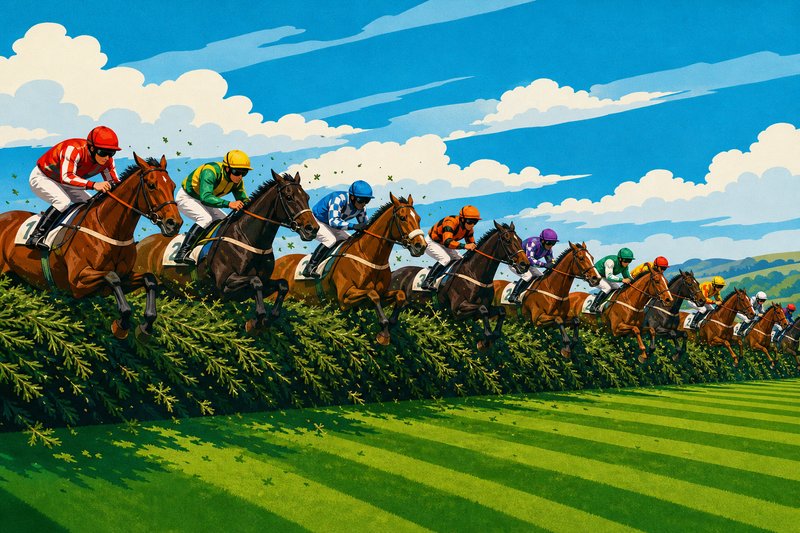
How many runners in the Grand National, and why it matters
The question of how many runners are in the Grand National is really a question about each way. Under the standard terms, a handicap with 16 or more runners pays four places at a quarter of the odds. With 34 runners, the race is well above that line, and even with several withdrawals it stays there.
That makes it very different from a small-field championship race. In a 34-runner field, being placed is hard, and so each way pays for itself on horses at the kinds of prices most Grand National runners go off at. A placed finish at 20/1 or 33/1 is worth a lot more than a placed finish at 3/1.
The runners also have to qualify. The race sets conditions, including a minimum age and a record over long distances over fences, that every entry must meet. Because the race is a handicap, each horse carries a weight based on its official rating, so the best-rated horses carry the most. That is the whole idea of a handicap: to give every horse a theoretical chance. It is also why the race is so hard to call.
Grand National each way places and extra-place offers
The standard Grand National each way places are the first four at a quarter of the odds. Many firms pay more on the Grand National, and it is common to see five, six or more places offered in the run-up to the race. The offers vary by firm and change from year to year.
An extra place is a straightforward improvement. £2 each way at 33/1 on a horse that finishes fifth returns nothing on standard four-place terms. On five-place terms at a quarter of the odds, the place half is paid at 33/4, and £18.50 comes back from £4. The terms on your bet are the ones that apply, so it matters which firm you bet with and when.
For a winner, the numbers get large quickly. £1 each way at 40/1 costs £2. If the horse wins, the win half returns £41 and the place half, at 10/1, returns £11, so £52 in total.
Two things to check before relying on extra places. First, whether the offer applies to the price you are taking and the time you are betting. Second, what happens if the field drops below a threshold, although for the Grand National that is unlikely to change the standard four places. The each way guide covers how terms are set and how dead heats for a place are settled.
Ante-post Grand National betting
Ante-post betting on the Grand National opens long before the race. Ante-post prices can be much bigger than the prices on the day, particularly for horses whose participation is still uncertain.
That uncertainty is the cost. A standard ante-post bet is lost if the horse doesn’t run, for any reason. In a race with a capped field, where some horses who are entered will not make the final list of runners, that risk is real. Some firms offer non-runner no bet on the Grand National in the weeks before the race, which refunds the stake if the horse doesn’t take part. It is worth the smaller price if your main worry is whether the horse will get a run at all.
Ante-post bets are normally outside Rule 4, because they are struck before the field is final. That means if a well-fancied horse is withdrawn late, your ante-post price isn’t reduced. Bets struck on the day at a fixed price are subject to Rule 4 deductions in the normal way. See ante-post betting and Rule 4 explained for the rules in full.
Grand National betting on the day
On the day of the race, the field is known and the prices are fully formed. Many firms offer best odds guaranteed on the race, which means that if you take a price and the horse starts at a bigger one, you are paid at the starting price. The terms vary by firm.
Prices can move a lot on Grand National day, because so much money is bet on the race. A horse that shortens sharply is attracting money, and a horse that drifts isn’t. Neither tells you the result, but the starting price will reflect all of it.
A practical point for anyone betting in a shop: it can be busy close to the off. Placing the bet in the morning, at a price or at the starting price, avoids the rush close to the off.
A small Placepot on Grand National day covers the first six races on the card, and is a way to have an interest in the whole afternoon rather than one race. Check the card to see whether the National itself falls inside those six.
Reading the field
A 34-runner racecard is a lot to take in, and it helps to know what to look for first. Because the race is so long, stamina matters more than in almost any other race: a horse that has only ever run over shorter trips is an unknown at this distance. Jumping matters too, because a mistake at any one of 30 fences can end the race. A horse’s record of completing its races over fences, rather than falling or unseating, is worth as much attention as its wins.
The weight is the third thing. In a handicap, the horses at the top of the weights are the best on the book, and they carry the most. The horses near the bottom carry less, but they are rated lower for a reason. The form guide explains how to read a horse’s record, and the going explains why the ground on the day can change which horses are suited.
None of this makes Grand National betting predictable. It gives a way of narrowing 34 names to a handful you have reasons for, which is more than a pin or a favourite colour can do.
Dead heats and the last place
With four or more places paid and a big field finishing over a long distance, a dead heat for the last paying place is always possible. The rule is the standard one: the place stake is divided by the number of horses sharing the places left.
Say two horses dead heat for fourth in a race paying four places at a quarter of the odds, and you had £5 each way on one of them at 20/1. The win half loses. Half the place stake, £2.50, is paid at 5/1, which returns £15 from the £10 you staked. The bet calculator settles dead heats for you if you pick the right result for your horse.
Sweepstakes, favourites and big prices
A sweepstake is not a bet with a bookmaker. Everyone puts the same amount in, draws a horse at random, and the pot is shared out according to the finishing positions, however the group decides. It is a fair game between friends and has nothing to do with the odds.
With a bookmaker, the prices matter. With so many runners, the favourite in the Grand National is normally a much bigger price than a favourite in a small field would be, because no single horse can be expected to beat 33 others. That, and the four places on offer, is why so many people bet each way at long odds rather than backing the favourite to win.
If you want to use a full-cover bet, remember that the Grand National is one race. You can’t put two horses from the same race in a double or a Lucky 15, but you can combine a Grand National selection with horses in other races on the card or at other meetings that day.
Whatever you bet, the each way calculator will show exactly what a placed or winning horse would return at your price and terms. Decide your stake before the day, and treat it as the cost of watching the race with an interest.