Cheltenham Festival Betting: How the Week Works, Race by Race
Four days, 28 races and a championship on each afternoon. Betting on the Cheltenham Festival is really two different jobs: the championship races and the handicaps.
Published
The Cheltenham Festival is four days of jump racing in March, from Tuesday to Friday, at Cheltenham Racecourse at Prestbury Park in Gloucestershire. There are seven races a day and 28 across the week, and each afternoon has a championship race at its centre, building to the Gold Cup on the Friday.
For anyone betting, the week splits cleanly into two kinds of race. The championships are small fields of the best horses in training, often with a short-priced favourite. The handicaps are big fields of good horses carrying different weights, where no horse is expected to beat the rest easily. Cheltenham Festival betting works very differently in each, and most mistakes come from treating one like the other.
How the festival week is structured
The four championship races give the week its shape. The Champion Hurdle is on the Tuesday, the Queen Mother Champion Chase on the Wednesday, the Stayers’ Hurdle on the Thursday and the Gold Cup on the Friday. Around them sit novice races for horses in their first season over hurdles or fences, the handicaps, a cross-country chase and races for amateur riders.
The festival used to run over three days. The fourth day is what gave each afternoon its own championship race. Every race is jump racing: there is no Flat racing at the festival at all.
It is useful to know the week’s shape before betting on it, because the right approach changes from race to race. A day that opens with a novice hurdle, builds to a championship race and ends with a big handicap asks for three different kinds of bet.
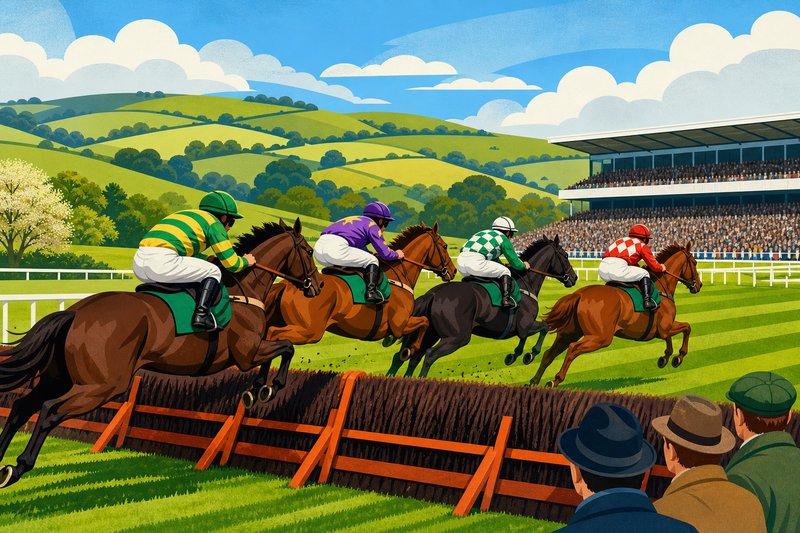
Cheltenham Festival betting on the championship races
The championship races attract the best horses, and the best horses tend to scare others away. Fields are often small, and the favourite can be very short. That changes the betting in two ways.
First, each way terms on a small field are less generous. An eight-runner non-handicap pays three places at a fifth of the odds, and a field of five to seven pays only two places at a quarter. With a short-priced favourite, a placed finish on a well-fancied horse often returns less than the stake. £10 each way at 5/1 on a horse that finishes placed in a race paying a fifth returns £20, exactly the stake back. At a quarter of the odds, the same bet would return £22.50. On anything shorter than 5/1 at a fifth, a placed horse loses money on the bet as a whole.
Second, odds-on favourites in championship races are beaten sometimes, and when they are, a lot of money goes with them. That doesn’t make opposing favourites a strategy. It does mean that a short price at Cheltenham is a statement of confidence, not a guarantee. Converting the price into a percentage, with the odds converter, is a good habit before taking one.
For many people, the championship races are for a win single on the horse they believe in, or a small full-cover bet across the four days, rather than each way.
The novice races
Alongside the championships, each day has races for novices: horses in their first season over hurdles or over fences. They are some of the best races of the week to watch, because they bring together the most promising young horses in training, often for the first time.
For betting, they have a particular character. Novices have less form than experienced horses, and what form they have was usually shown against weaker opposition. Their jumping is less tested, too, which matters more in the novice chases. A horse that has won every race it has run in can still be a question mark on its first run at this level.
That means the prices in novice races are built on less evidence than in the championships. A short price on an unbeaten novice is a judgement on potential as much as on proof. It is worth reading the form closely, looking at who the horse has actually beaten, rather than just the run of wins. The form guide explains how.
The handicaps: big fields and four places
The handicaps are where each way comes into its own. Races with names such as the County Hurdle, the Pertemps Final, the Kim Muir and the Grand Annual often attract fields of 16 runners or more, which under the standard terms pay four places at a quarter of the odds. Many firms also offer extra places on the festival handicaps, and those offers vary from firm to firm.
A handicap gives every horse a weight based on its rating, aiming to give each an equal chance on paper. At Cheltenham, where trainers target these races for months, the fields are especially competitive, and a big-priced winner is always possible. That is exactly the kind of race where the place half of an each way bet pays for itself. A placed finish at 16/1 or 20/1 in a race paying a quarter of the odds is a good return on the stake.
It also means the handicaps are hard. There is no shame in leaving one alone, or covering it only with a line in the Placepot. The handicaps are also where the draw of extra places can tempt people into betting on races they have no real opinion about.
Ante-post Cheltenham Festival betting
Ante-post markets on the championship races and many of the others are open for months before the festival. They are where the biggest prices on the eventual favourites are often found, and also where the most money is lost on horses that never run.
The problem is specific to Cheltenham. Many horses are entered for more than one race at the festival, and their trainers don’t decide which one to run in until close to the day. A horse backed ante-post for one race may turn up in another, or not at all. With a standard ante-post bet, the stake is lost if the horse doesn’t run in the race you backed it for.
That is why non-runner no bet is so widely offered in the run-up to the festival. It refunds the stake if your horse doesn’t take part in that race, and it removes the biggest risk of betting early. The price is usually a little shorter than a standard ante-post price, but the protection is often worth more than the difference. The offers vary by firm, and the conditions are worth reading. Ante-post betting explains the rules.
Betting on the day at Cheltenham
On each morning of the festival, the fields are known and bookmakers publish prices on every race. Many firms offer best odds guaranteed on festival races, which pays the starting price if it is bigger than the price you took. The terms vary.
The going is the other thing that becomes clear on the day. Jump racing in March can be run on anything from good to heavy ground, and some horses only show their best on one or the other. The official going is published by the course and can change during the week if it rains or dries out. It is worth checking before every day’s betting. The going explained covers what the descriptions mean.
Non-runners work the same way at Cheltenham as anywhere else. A bet struck on the day on a horse that is withdrawn is void and the stake comes back. If another horse is withdrawn too late for the market to re-form, a Rule 4 deduction comes off the winnings on fixed-price bets. With so many horses holding entries in more than one race, withdrawals happen in the days before a race as trainers make their choices, which is another reason to check the final field before betting. Rule 4 explained has the deduction table.
Keeping a stake under control over four days
Twenty-eight races is more than most people would bet on in a month. £5 on each is £140, and £5 each way on each is £280. It is easy to reach those figures without meaning to, one race at a time.
The simplest way to avoid that is to decide a total for the whole week before the first race and divide it by the races you actually want to bet on. Most people have a real opinion on a handful of races and a vague one on the rest. The vague bets are the ones that turn a winning week into a losing one.
It also helps to decide in advance what you will do after a bad day. The last day of the festival includes the Gold Cup and a card of big handicaps, and it is a tempting time to try to win back the week’s losses in one go. Setting the limit beforehand removes that decision from the moment. The bet calculator will show the full cost of any bet before you place it.
Multiples and full-cover bets over the week
A popular way to follow the four championship races is a Yankee or Lucky 15 with one horse in each. It gives an interest in all four days for one stake. Because championship favourites are often short, the returns on the singles and doubles can be modest, and most of the value sits in the trebles and the four-fold.
Doubles and trebles on the handicaps are much harder, and the prices reflect it. A double on two festival handicap winners is a long shot by any measure, which is why the returns look so large. Cheltenham Festival betting in multiples works best when each leg is a horse you would back as a single anyway.